
By Ricardo Rascon, Director of Marketing at Tetakawi · Updated
KEY TAKEAWAY
Querétaro is Mexico’s deepest aerospace ecosystem, and for the right operation it is hard to beat. But record investment is filling its space, power, and water faster than the Bajío can add them, which turns location into a question of fit. Manufacturers that need to sit inside a mature supply base and can fund a scarce, high-cost workforce belong in Querétaro. Those that need new, scalable capacity on a workforce they can hire and keep are increasingly better served by Mazatlán, on Mexico’s Pacific coast, where a 29,000-student talent pipeline, uncontested grid and water, a deep-sea port, and a launch in as little as 30 days offer the headroom Querétaro no longer has.
To manufacture in Querétaro is to plug into Mexico’s most concentrated aerospace-engineering cluster: roughly 85 aerospace companies, a purpose-built aeronautical university, and anchors like Safran, GE Aerospace, and Airbus Helicopters clustered in the Bajío. It is a world-class place to run precision work, for the right operation. The more valuable question for a site-selection team is not whether Querétaro is good, but whether it fits the operation you are actually placing, because the same density that makes it excellent is also making it full.
This is a decision read. It covers what manufacturing in Querétaro is genuinely built for, where the market is tightening, and where Mazatlán, on Mexico’s Pacific coast, is the better build for a large and growing share of manufacturers.
What Querétaro Is Built For
Querétaro is built for operations that need to sit inside a mature aerospace supply base and can fund the workforce to run there. The cluster has compounded for two decades into the densest aerospace ecosystem in Mexico, and the investment has not slowed. On , Safran inaugurated a US$140 million engine MRO complex in Querétaro, designed for up to 350 engine shop visits a year and set to become Safran’s largest maintenance center in the world.
“This facility places the Querétaro site at the heart of Safran Aircraft Engines’ maintenance network in the Americas.”
— Stéphane Cueille, CEO, Safran Aircraft Engines
The cluster association counts more than 60 member organizations and reported roughly 10 percent growth in 2025, on cluster output that passed $2.8 billion in 2024. It is also one of Mexico’s safer manufacturing states, which belongs on any site-selection scorecard. If your operation depends on being physically next to the aerospace supply chain, on shared certifications and a deep bench of specialized suppliers, and you have the scale to fund a premium workforce, manufacturing in Querétaro is hard to beat. None of that is in dispute, and none of it should be talked down.
Where Querétaro Tightens
What are the real constraints on manufacturing in Querétaro?
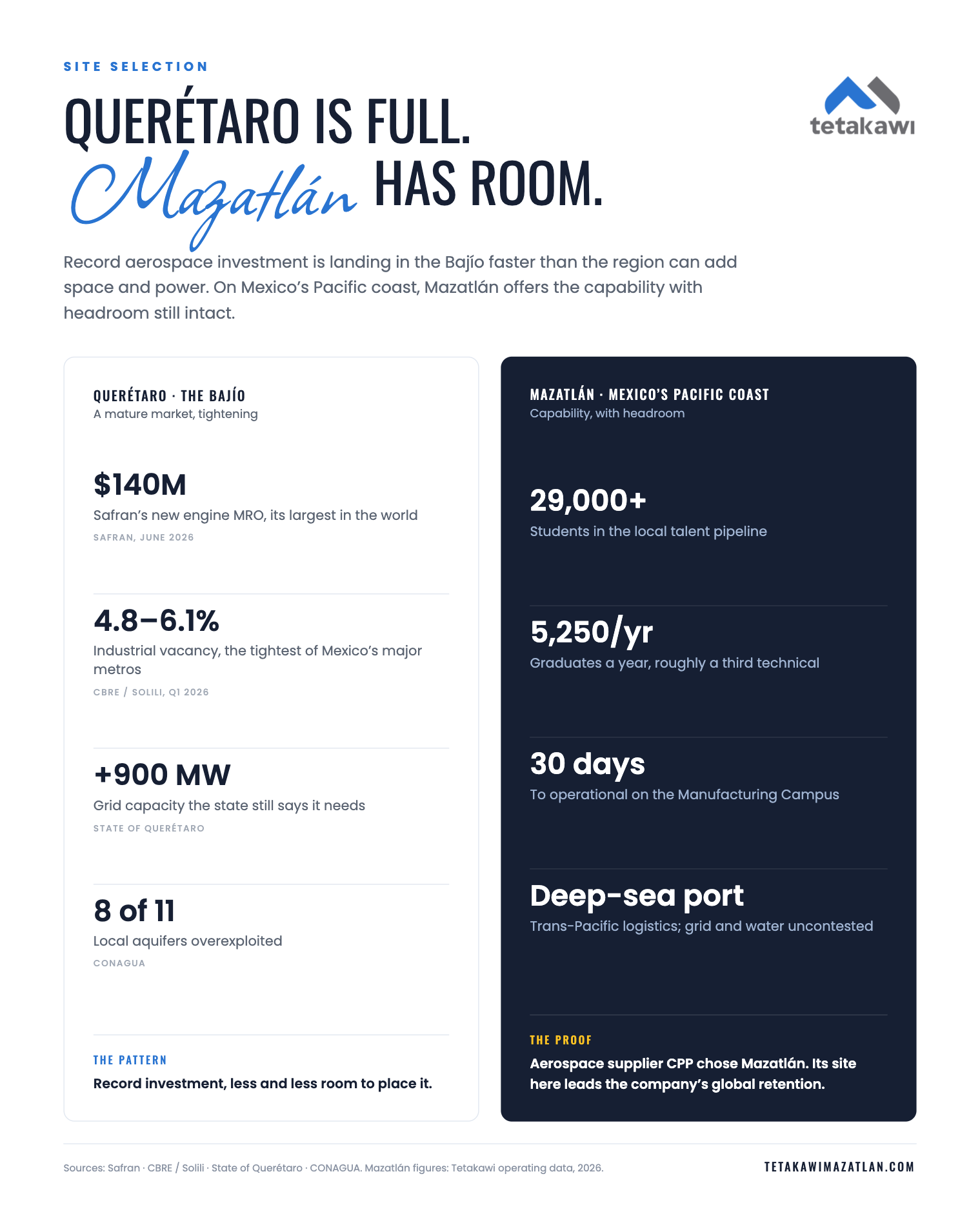
Space, power, and water, all tightening at once as the cluster fills. Together they set the real price of manufacturing in Querétaro. The metro runs the tightest industrial vacancy of Mexico’s major manufacturing metros, in the 4.8 to 6.1 percent range in early 2026 depending on the source, with Bajío-high rents still climbing 5 to 10 percent, buildings leasing before they finish, and 18-to-24-month lead times for a new build. The flagship aerospace park has less than 15 percent of its land left.
Infrastructure is the harder ceiling, and it is arriving faster than most site-selection models assume. Querétaro holds an estimated 65 to 79 percent of Mexico’s installed data-center capacity, and that boom now competes with manufacturing for the same grid and aquifers. State electricity demand has grown near 6 percent a year against a national average around 3 percent; data centers alone have requested 540 megawatts, the state estimates it needs 900 more, and industry reporting flags up to 35 percent of planned 2024-to-2026 industrial investment as exposed to power-related delay. On water, Querétaro is among Mexico’s most water-stressed states, with 8 of 11 aquifers overexploited and a water emergency declared across most of its municipalities in 2025.
Labor is the third pressure, and for most operators the decisive one. Recruitment research from KiTalent puts the average technical role in the cluster at 67 days to fill, a general machinist at roughly 45, and a NADCAP-certified NDT Level II inspector at 120 to 150 days. Unemployment among certified quality managers sits below 2 percent, which means the people you need already have jobs, and growth happens by poaching. The market prices that in: premiums of 15 to 20 percent for bilingual capability, about 25 percent on top of manufacturing pay for NADCAP knowledge, and 35 to 40 percent for emergency senior relocations.
The supply side explains why the gap is structural rather than cyclical. The Universidad Aeronáutica de Querétaro (UNAQ) graduated around 412 aerospace engineers and technicians in 2023, roughly a third of them in directly manufacturing-relevant tracks, and the state licensed about 240 new aircraft-maintenance technicians across all institutions in 2024, against demand KiTalent estimates at 1,300 to 1,400 additional workers by 2026. It is telling that Aernnova opened a satellite office in Guadalajara because the avionics and software talent it needed was not available locally. Anyone planning to manufacture in Querétaro at volume runs into this first: the investment pipeline is priced for a workforce that does not yet exist at the scale required. None of this is decline. It is a market so successful that it is running short of room.
The Two Profiles
Site selection for aerospace has quietly changed its question. For a decade it was “where is the ecosystem?” and Querétaro was the answer. When the ecosystem is mature, the binding question becomes “where can I actually staff and power what I build?” That splits manufacturers into two profiles.
The first is the Tier 1 or OEM that needs to sit inside the supply base, runs MRO or engineering-intensive work, and can pre-fund a two-year talent pipeline and premium wages. For that company, manufacturing in Querétaro still works, and the density is worth the cost. The second is the Tier 2 or Tier 3 supplier that needs new, scalable capacity, a predictable cost structure, a line running in months rather than years, and people it can retain. That company cannot win a 40 percent poaching war for inspectors, and it should not have to. For that profile, the mature market is the risk, not the reward, and there is a specific alternative on the other side of the country.
The Mazatlán Alternative
Where should new aerospace capacity go instead?
The alternative to manufacturing in Querétaro at scale is not another Bajío city; it is a different coast. Mazatlán, on Mexico’s Pacific, offers the profile Querétaro had a decade ago: certified capability within reach, a deep and growing workforce, and a grid and water table no one is fighting over yet. Three things make it a build, not a bet.
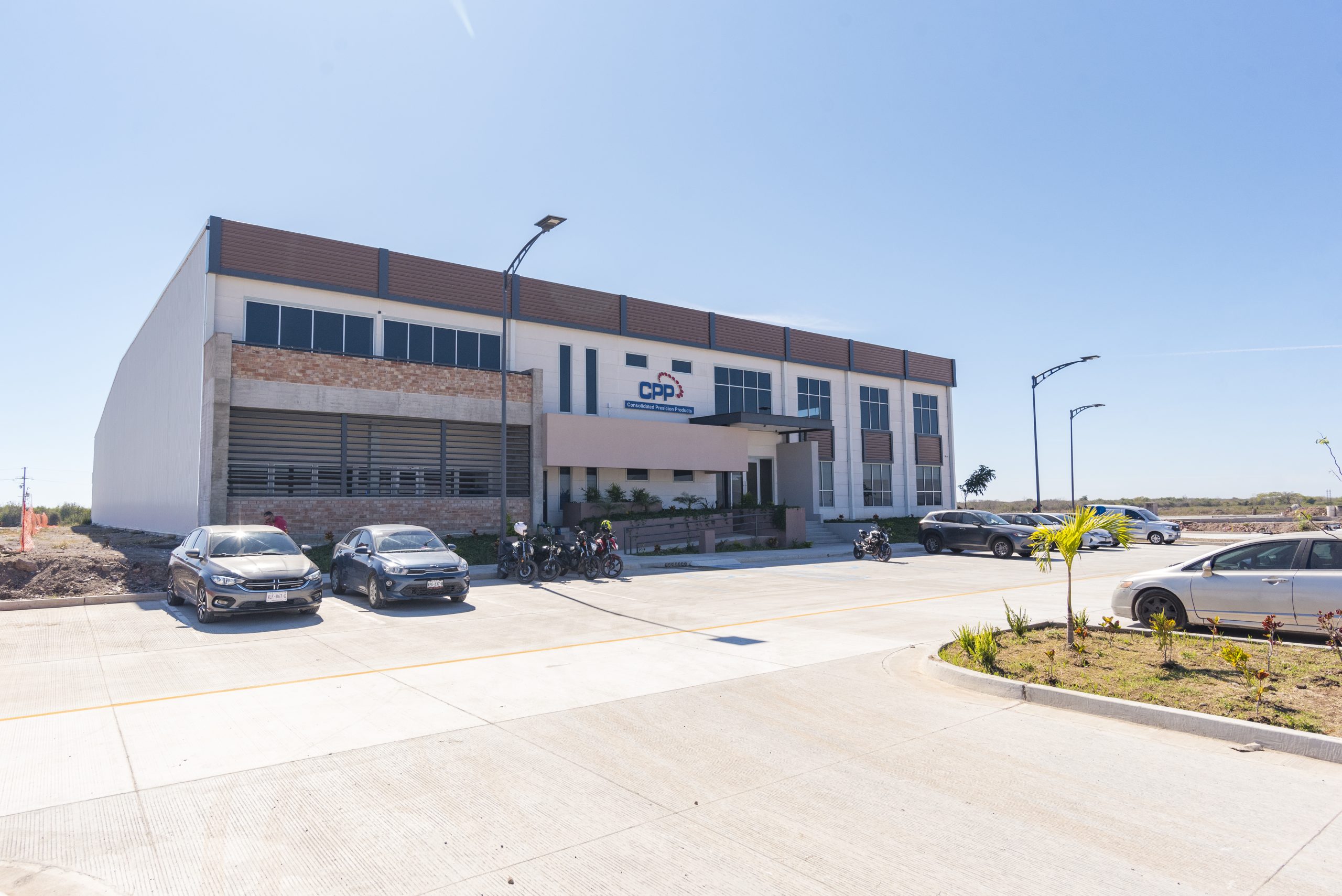
The first is proof, and it is an aerospace operator’s. Consolidated Precision Products, an aerospace casting supplier, has run operations both standalone in Ensenada and on Tetakawi’s Guaymas campus, inside a Sonora aerospace base that has carried certified work for decades. When it came time to grow, CPP chose Mazatlán, and its Mazatlán site now leads the company’s global operations in employee retention. That is the whole argument in one operator: certified aerospace work, in Mazatlán, on a workforce that stays. Our aerospace location analysis and the CPP case study walk through how that capacity stands up, and CPP’s leadership tells the story directly:
The second is the workforce itself. The Mazatlán talent pipeline draws on more than 29,000 students and over 5,250 graduates a year, roughly a third in technical fields, with a median age of 31, more than 500,000 people within a 30-mile radius, and the local workforce growing 6.1 percent over five years. Because it is a place people want to stay, retention runs high, and retention is what turns a workforce number into a cost advantage that holds. It is a pipeline a supplier builds on rather than bids for. A closer look sits on the Mazatlán workforce page.
The third is the Manufacturing Campus (the Manufacturing Community). Rather than assemble a legal entity, real estate, utilities, and administration yourself over 8 to 12 months, Tetakawi’s campus model can have you operational in as little as 30 days under a single U.S.-based contract, with Tetakawi as your employer, importer, and manufacturer of record. The ground is new only in geography: Tetakawi has operated manufacturing communities in Mexico for more than 40 years and today supports 60+ manufacturers and 22,000+ employees across five campuses. The grid and water are uncontested, campus space is available now, and Mazatlán’s deep-sea port, international airport, and highway and rail links put you on the right ocean for trans-Pacific supply chains rather than a continent of drayage from the border. For a supplier placing new capacity, that is a faster, lower-risk build than entering a saturated market.
The honest tradeoff belongs on the table too. What Mazatlán does not give you is a supplier on the next street; manufacturing in Querétaro keeps special-process vendors and customers within an hour, and for operations that live on daily supplier hand-offs, that proximity is worth paying for. For operations whose parts ship, like castings, machined components, and assemblies bound for the U.S. or Asia, the tradeoff runs the other way, and the cost math reinforces it: in Tetakawi’s cost modeling, fully loaded operator costs on the Pacific coast run below Bajío averages before retention is counted, and every point of turnover you do not have is training, scrap, and requalification you do not pay for.
How to Choose
The decision comes down to a handful of honest questions. Does your operation have to be physically inside the aerospace cluster, or does it only need to be certified and capable? Can you fund a scarce, premium workforce for years, or do you need to hire and retain at a predictable cost? Do you need a line running in months, or can you wait 18 to 24 for a build? Which ocean is your supply chain on? If your answers lean toward capacity, cost, retention, and speed, the Mazatlán build is the stronger call. The point is not that Querétaro is failing; it plainly is not. It is that the two markets solve different problems. For the profile that must live inside the cluster, manufacturing in Querétaro remains the right build; for the profile that needs new, scalable capacity at a predictable cost, Mazatlán is. Knowing which is yours before you sign a lease is the entire site-selection exercise. The broader site-selection framework puts the workforce question first, where it belongs.
| Decision variable | Querétaro (Bajío) | Mazatlán (Pacific) |
|---|---|---|
| Aerospace ecosystem | Deepest in Mexico; mature | Proven by CPP; room to grow |
| Workforce | Scarce, high-cost, poached | 29,000+ students; retention-driven stability |
| Trans-Pacific access | Inland; trucked to either coast | Deep-sea port on the Pacific |
| Industrial real estate | Tightest metro; <15% park land left | Campus space available now |
| Grid & water | Contested with data centers | Not yet contested |
| Time to operational | 18–24 months for a new build | As little as 30 days on-campus |
Frequently Asked Questions
Is Querétaro good for aerospace manufacturing?
Yes, for the right profile. Manufacturing in Querétaro means plugging into Mexico’s deepest aerospace cluster, with roughly 85 companies and anchors like Safran’s new US$140 million engine MRO center. It is an excellent fit for MRO, engineering-intensive work, and companies that must sit inside the supply base and can fund a premium workforce. It is a harder fit for suppliers that need new, scalable capacity fast at a predictable cost.
How hard is it to hire certified technicians in Querétaro?
Hard, and slow. Recruitment research puts the average technical role at 67 days to fill and a NADCAP NDT Level II inspector at 120 to 150 days, with certified-quality-manager unemployment below 2 percent. Because most qualified people already have jobs, hiring often means poaching, at premiums of 15 to 40 percent depending on the certification and urgency.
What are the main constraints on manufacturing in Querétaro?
Three tighten together as the cluster fills: the tightest industrial real estate of Mexico’s major metros (under 15 percent land left in the flagship aerospace park, 18-to-24-month builds), a power and water squeeze intensified by a data-center boom that holds most of the country’s installed capacity, and a certified-labor market where key roles take 120 to 150 days to fill. None is disqualifying, but all three belong in the cost model.
Where else in Mexico can aerospace or precision work go?
Mazatlán, on Mexico’s Pacific coast, is the clearest alternative for new capacity. Aerospace supplier CPP, which has operated both standalone and on a Sonora campus, chose Mazatlán, and its site there now leads the company’s global retention. The Mazatlán Manufacturing Campus reaches production in as little as 30 days under a single U.S.-based contract, on a talent pipeline of more than 5,250 graduates a year, with a deep-sea Pacific port and uncontested grid and water.
Deciding Where to Place New Capacity?
We model the workforce, cost, and infrastructure realities of Querétaro and Mazatlán against your actual operation, so the location decision is made on evidence, not reputation.