

By Ricardo Rascon, Director of Marketing at Tetakawi · Updated
KEY TAKEAWAY
No, the USMCA is not gone. The agreement is still in effect: absent a party’s earlier withdrawal, it runs until July 1, 2036, and the parties can agree to a fresh 16-year extension at any point before then. On July 1, 2026, the United States declined to renew it at its six-year review, which sounds terminal and is not: the pact now gets reviewed annually while it continues to operate. The border variable a manufacturer can most directly influence is qualification, because Canadian and Mexican goods entered free of duty under the USMCA are exempt from the current tariff surcharge and have ultimately received exemptions from each across-the-board tariff action of the past 18 months. By U.S. Census figures, the share of Mexican import value claiming USMCA treatment jumped from roughly 46 percent in January 2025 to roughly 87 percent in January 2026. In each major North American tariff episode examined here, preferential North American trade ultimately received an exemption, the threatened measure never took effect, or the measure was later removed or invalidated.
TARIFF DISCLOSURE
Trade policy is moving quickly. Every figure in this article was verified as of , against primary sources and the cited analyses, including the Section 122 surcharge, which expired as scheduled at 12:01 a.m. EDT on July 24, 2026, and the Section 301 action announced July 23, 2026 that succeeded it. Note also that on May 7, 2026, the Court of International Trade held that surcharge unlawful and granted relief to the named importer plaintiffs and Washington State; the Federal Circuit subsequently stayed that relief pending appeal, and CBP continues to collect it. Confirm current rates with your customs counsel before making commitments.
IN THIS ARTICLE
What Actually Happened
The Sunset Clause, Explained
The Number That Moves Your P&L
The Playbook: What Each Country Can Actually Do
The Pattern So Far: Escalation, Then an Off-Ramp
So, Will Things Stay Predictable?
Qualification Is the Game
Where You Build Decides How Easily You Qualify
What to Watch Next
Frequently Asked Questions
On the morning of July 1, 2026, trade officials from the United States, Mexico, and Canada logged into a video call for a meeting the agreement itself had scheduled six years earlier. When it ended, the Office of the U.S. Trade Representative released a statement containing one sentence that launched a thousand alarmed headlines: “The United States did not agree to renew the USMCA in its current form. As a result, the USMCA is not renewed.”
If you read that and concluded North America’s trade agreement just died, you are in good company, and you are wrong. What happened on July 1 was not an expiration. It was a scheduled vote on whether to reset a clock, and the United States chose not to reset it. Understanding the difference is worth fifteen minutes of any manufacturing executive’s time, because the gap between what the headlines imply and what the agreement actually says is where good location and sourcing decisions are being made right now.
What Actually Happened
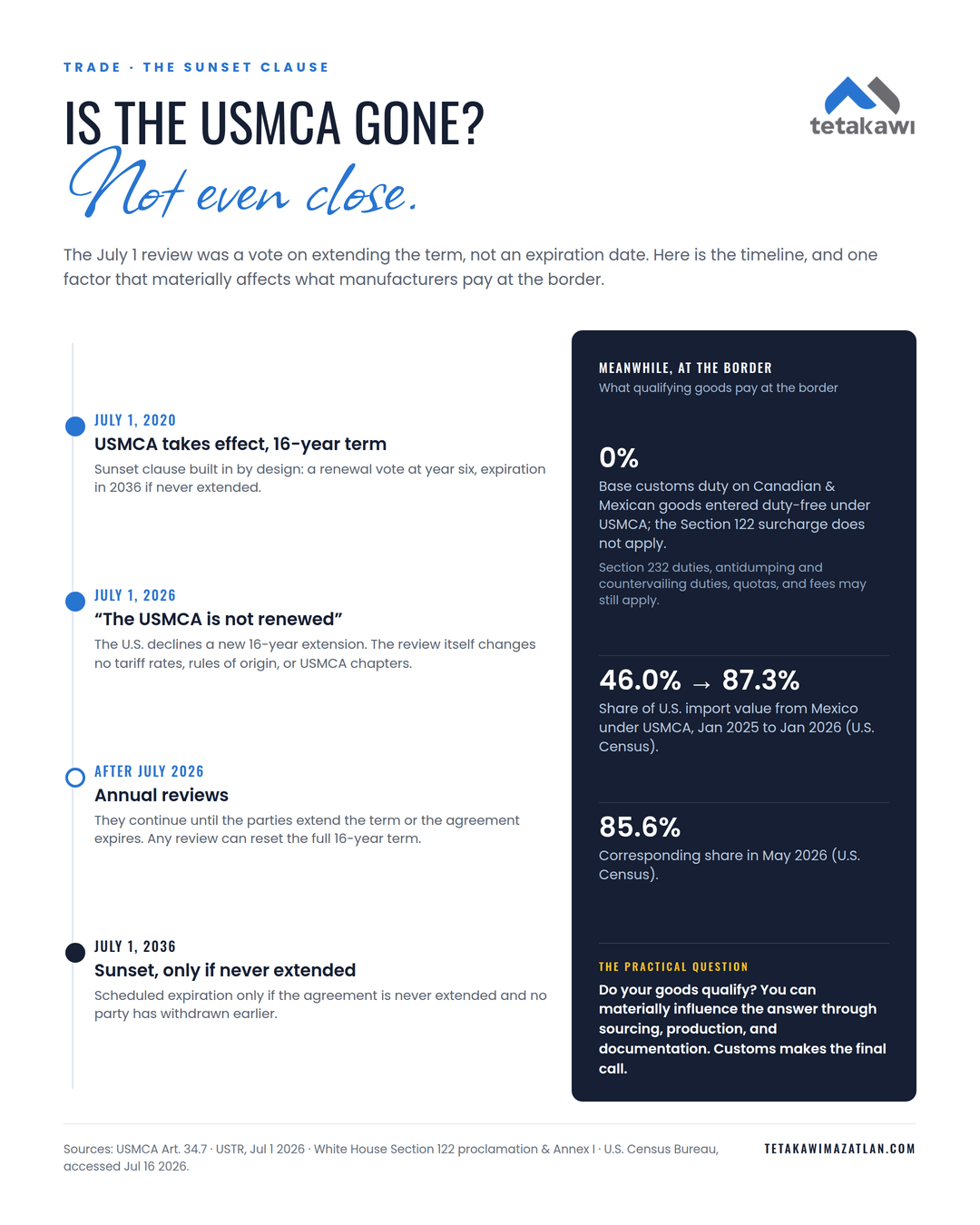
The USMCA took effect in 2020 with an unusual feature that its own architects insisted on: a 16-year lifespan, ending July 1, 2036, with a mandatory check-in at year six. At that review, all three countries had to affirmatively agree to renew, which would have reset the clock to a fresh 16-year term. Mexico and Canada came ready to renew. The United States declined. President Trump has signaled he wants a renegotiated version rather than a simple extension, telling reporters, “I would rather not have the agreement, but I may sign it,” and he has called the sunset clause his favorite feature of the deal.
That is the whole event. No tariffs changed on July 1. No rules of origin changed. No chapter of the agreement was suspended. The parties committed to keep talking, and a third round of U.S.-Mexico negotiations concluded in Mexico City on July 23, with a fourth round expected in early September.
The Sunset Clause, Explained
So is the USMCA still in effect?
Yes, fully, and by design it stays that way for years. Declining to renew did exactly one thing: it switched the agreement from autopilot to annual check-ins. Here is how the sunset clause works in plain terms. Because the 2026 review did not produce a renewal, the three countries will now hold a joint review every year. At any one of those annual reviews, and formally at any point in between by written confirmation of the three governments, the parties can agree to extend, which resets the full 16-year term as if the hesitation never happened. If they never agree, the agreement runs under its current terms until it terminates on July 1, 2036, a decade from now. Canada’s trade minister put it plainly: the USMCA “remains fully in force until 2036 and may be renewed at any time.” Mexico’s Economy Ministry said the same thing in fewer words: the agreement is not ending and will not be modified in the short term.
One more piece of context the panic coverage skips: any country has always been able to leave the USMCA with six months’ written notice, since the day it took effect. That door did not open on July 1. It has been there the entire time, unused, because the integrated North American supply chain is worth more to all three economies than the leverage of walking away. What the non-renewal really creates is an annual negotiating table, and leverage at a table is a very different thing than an exit.
The Number That Moves Your P&L
While the diplomatic story plays out on a ten-year clock, the money story has been decided month to month, and it turns on one word: qualification.
Recall the sequence. In early 2025, sweeping tariffs landed on North American imports, but goods that met USMCA rules of origin were carved out within days of the duties taking effect. In February 2026, the Supreme Court ruled that IEEPA gave the president no tariff authority at all, voiding the 25 percent duties built on it. What remains as of this writing is a 10 percent Section 122 surcharge, from which Canadian and Mexican goods entered duty-free under the USMCA are exempt, alongside a long list of product-specific carve-outs running from civil aircraft to Section 232-covered goods, and that surcharge expired on schedule at 12:01 a.m. EDT on July 24, 2026; a Section 301 action announced July 23 succeeded it the same day, again exempting USMCA-qualifying goods. The surcharge is also in the courts: on May 7, 2026, the Court of International Trade held it unlawful and granted relief to the named importer plaintiffs and Washington State; the Federal Circuit subsequently stayed that relief pending appeal, and CBP continues to collect the surcharge. Through all of it, one thing held: Canadian and Mexican goods entered free of duty under the USMCA ultimately received exemptions from each across-the-board tariff action, so many qualifying manufactured goods enter at a zero base customs duty. In March 2025 that exemption took effect three days after the duties began; under the current Section 122 surcharge it applied from the start. Zero here means the ordinary customs duty, not necessarily the whole border bill: Section 232 duties on metals and vehicle content, antidumping and countervailing orders, quotas, processing fees, and other product-specific charges ride separately where they apply, which is why the number worth modeling is total landed cost, not the headline rate.
Mexican industry noticed. In January 2025, by U.S. Census figures, roughly 46 percent of the value of U.S. imports from Mexico claimed USMCA preference; many importers had never bothered with the paperwork because the duty savings were small. One year later, with qualification acting as a tariff shield, the January 2026 share had jumped to roughly 87 percent, and it has held near 85 percent since. That is a compliance migration of unusual speed, and it reframes the entire USMCA question. The agreement did not get weaker in the last 18 months. For anyone shipping qualifying goods, it became one of the most valuable pieces of paper in North American trade.
The Playbook: What Each Country Can Actually Do
Annual reviews mean annual headlines, so it is worth knowing exactly which tools each government is holding and how far each one reaches.
What Washington can do
The White House is emphasizing four principal trade-policy mechanisms right now (the statutory toolbox is broader, safeguards and antidumping law included), and each operates under its own scope, procedure, and legal constraints. The first is the annual review itself, where leverage means demands rather than exits. Legal and policy reporting has described possible U.S. proposals that USTR has not publicly released: raising automotive regional value content from 75 to 82 percent with a 50 percent U.S.-content share, lifting heavy-truck content thresholds, and tightening steel and aluminum sourcing rules so Chinese inputs cannot ride along inside qualifying goods. USTR has confirmed that automotive rules of origin are under discussion. Read that list again. Those are the demands of a government currently using the agreement as a negotiating platform, not one treating the July 1 review as the beginning of the end.
The second lever is Section 232, the national-security statute behind the current metals tariffs, which run as high as 50 percent depending on the product, its content, and where the metal was melted and poured. It has survived the courts, and it is product-by-product by design, which is also why it keeps producing carve-outs: even inside the Section 232 vehicle tariffs, importers of USMCA-qualifying automobiles can obtain treatment that applies the tariff only to the vehicle’s non-U.S. content, subject to Commerce approving the U.S.-content calculation. The third is Section 301, the unfair-trade-practices statute, historically concentrated on China and now deployed far more broadly: USTR opened investigations touching some 60 economies in March 2026 and proposed action in June. The fourth is Section 122, the 10 percent surcharge in force today, and it is the most constrained of the four by design: the statute caps it at 15 percent and 150 days unless Congress votes to extend it, which is why it expires July 24. It was built with a fuse, and a court has already challenged the hand that lit it.
And the withdrawal letter? Article 34.6 permits the United States to withdraw on six months’ written notice. Whether a president may withdraw the United States unilaterally from a congressional-executive agreement remains legally disputed and would likely generate litigation. Related disputes have reached the courts, but the allocation of withdrawal authority has not been definitively resolved for the USMCA. The Supreme Court’s February ruling showed how those cases can end: tariff power belongs to Congress, and presidents borrow it within statutory limits. Add the politics, since Mexico is the United States’ largest goods trading partner and, as of 2025, the largest buyer of U.S. goods exports, and the exit door starts to look more ornamental than operational.
What Mexico can do
Mexico’s strategy has been on public display for 18 months: stay at the table and trade cooperation for stability. President Sheinbaum calls the posture keeping “a cool head,” and her government has backed it with the currency Washington values most right now. Border Patrol apprehensions between ports of entry fell from more than 2.2 million in fiscal 2022 to roughly 238,000 in fiscal 2025; whatever the mix of causes behind that drop, it is a trend Washington prizes and Mexico claims a share of the credit for, alongside fentanyl cooperation. Mexico has also moved against Chinese transshipment with its own tariff measures. That cooperation is tradeable precisely because it is renewable every year, the same cadence as the reviews.
Mexico also has harder cards. It can redirect its own buying, and it says so out loud: when U.S. negotiators floated seasonal restrictions on Mexican produce, Economy Minister Ebrard drew a public red line and noted Mexico could source its agricultural imports elsewhere. What Mexico has conspicuously not done is retaliate broadly, and that restraint is the strategy. Roughly 88 percent of Mexican exports enter the U.S. duty-free, and by Chatham House’s July 2026 estimate the average effective tariff on Mexican goods sits near 3.4 percent, against roughly 22 percent for Chinese goods. Mexico’s best move is to protect that spread, and everything it has done since 2024 says it knows it.
What Canada can do
Canada’s position is the simplest of the three: it already voted to renew. At the July review, Canada and Mexico both agreed to extend the pact for a fresh 16-year term; the missing signature was Washington’s. Canada formally confirmed that it favored extending the agreement and has continued consultations with U.S., Mexican, provincial, and industry counterparts while it pushes trade diversification at home. The arithmetic is the part worth remembering: on the positions stated at the July review, extension requires Washington to change course, and Washington is currently negotiating amendments to the very agreement it declined to extend.
The Pattern So Far: Escalation, Then an Off-Ramp
Predictability is an empirical question, and there is now eight years of evidence. Consider what has actually been thrown at North American trade, and what happened next.
In 2018, Section 232 steel and aluminum tariffs hit Mexico and Canada; they were lifted in May 2019 to clear the path for USMCA ratification. In May 2019, President Trump announced escalating tariffs on all Mexican goods, 5 percent rising toward 25 percent, over migration; eight days later they were called off after a joint declaration, having never taken effect. In early 2025, 25 percent IEEPA tariffs were announced against Mexican and Canadian imports; they were paused within days, and when they finally took effect that March, USMCA-qualifying goods were carved out three days later, an exemption that never lapsed and that the April 2025 reciprocal-tariff order preserved. In February 2026, the Supreme Court struck down those tariffs’ legal basis entirely. When the replacement Section 122 surcharge arrived that same month, the USMCA exemption was carried over from day one, the same carve-out surviving its change of legal clothes. Weeks later, when the administration announced it would raise that surcharge from 10 to 15 percent, no proclamation was ever issued, and the rate never moved. And in May 2026, the Court of International Trade held the Section 122 surcharge itself unlawful; collection continues under a stay while the appeal runs, but a second tariff authority in eighteen months now stands judicially wounded.
Seven flashpoints, one pattern: maximal announcement, then a negotiated off-ramp, a carve-out, a court, or a quiet shelving. Read that as analysis rather than a law of nature; the honest ledger includes the exception, because the Section 232 sectoral tariffs have come back and stayed, and no past carve-out legally binds a future administration or Congress. But the constant running underneath eight years of escalations still matters for a manufacturer: in the episodes examined here, no blanket tariff has held on duty-free USMCA entries for more than three days. The carve-out for qualifying goods has been among the most durable features of U.S. trade policy toward Mexico, more durable than any single statute it rode in on.
So, Will Things Stay Predictable?
Two different kinds of stability are getting confused in this debate, and separating them is the entire argument. The policy weather, meaning the headlines, the threatened rates, the announcement-and-walkback cycle, will stay noisy, and the annual reviews guarantee a scheduled storm season every year through 2036. No one can credibly promise calm.
The operating floor is a different matter. The question executives keep typing into search bars, is the USMCA still in effect, has had the same answer every day since 2020: yes. Through two administrations, three tariff statutes, two court rulings, and a non-renewal, the floor under qualified North American trade has not moved. Duty-free USMCA entries kept moving through all of it; what changed was the paperwork premium on qualifying, which is why the claimed share nearly doubled in a year. The honest professional read: plan for noisy weather, and build on the floor. Companies that treat every announcement as an existential event will exhaust themselves reacting to tariffs that never take effect. Companies that secure qualification and document it operate at the preferential rate much as they did last year and the year before.
Qualification Is the Game
Qualifying is not automatic, which is exactly why it separates manufacturers. Every product has a rule of origin, generally some combination of a tariff-shift test, meaning non-North American inputs must be transformed into something new in the region, and a regional value content threshold, meaning a set share of the product’s value must originate in North America. Automotive runs the strictest version at 75 percent regional value content plus labor value content requirements. Behind every certification of origin sits a documentation chain: supplier certificates, bills of materials, production records that survive an audit.
None of that is exotic, but it is operational work, and it explains why in 2024, before the tariff shock, more than half the value of U.S. imports from Mexico and Canada did not claim preference at all. In our experience, the manufacturers who cleared the bar quickly in 2025 were the ones whose operations were built to produce the evidence, not just the product. For the full mechanics of the review and compliance picture, our team’s USMCA review guide goes deeper than this article can.
Where You Build Decides How Easily You Qualify
What does any of this have to do with site selection?
More than the policy coverage suggests. Regional value content is earned on the factory floor: where your inputs come from, how much transformation happens in-region, how much North American labor is in the product, and whether the records prove all of it. Those are location and operating-model decisions made long before a customs form is filed.
It is also where the operating model quietly matters most. On a Tetakawi Manufacturing Campus (the Manufacturing Community), Tetakawi serves as the importer and manufacturer of record, with in-house trade-compliance and customs teams handling certifications, supplier documentation, and audit trails as part of daily operations rather than as a scramble after a tariff announcement. The national numbers show why that infrastructure matters: when qualification became the shield in 2025, the USMCA-entered share of Mexican import value had to climb from roughly 46 to 87 percent in a single year. In Tetakawi’s experience, the manufacturers positioned to respond in weeks rather than quarters were the ones whose supplier-documentation and audit trail already existed. For a manufacturer weighing new North American capacity, including on Mexico’s Pacific coast in Mazatlán, where labor headroom and a deep-sea port meet the campus model, qualification readiness is part of what the location buys you. Our site-selection framework and the campus model cover how that works in practice.
It is also a number you can put on paper before committing to anything. Tetakawi runs a USMCA cost analysis for manufacturers weighing a Mexico build: your bill of materials mapped against the rules of origin for your products, the regional value content math under today’s thresholds and under the stricter ones on the negotiating table, and the landed-cost gap between shipping as a qualifying versus a non-qualifying exporter. In Tetakawi’s cost analyses, that gap often ranks among the largest landed-cost line items, alongside labor, rent, and freight. And if the 82 percent automotive proposal survives negotiation, the same analysis shows how much headroom your sourcing plan has before it stops qualifying, which is the question worth answering before the annual reviews answer it for you.
What to Watch Next
Three dates carry most of the signal. The third round of U.S.-Mexico talks concluded July 23, 2026, in Mexico City, with reported progress on steel and aluminum and an unresolved gap on automotive content; a fourth round is expected in early September. On July 24, 2026, the Section 122 surcharge expired on schedule, and its successor arrived the same day: a Section 301 action announced July 23 adds duties of 10 to 12.5 percent on imports from more than 60 economies, with USMCA-qualifying goods of Mexico and Canada exempt once again. Watch the Federal Register notice for the final product lists, and the pending Section 232 medical-supplies investigation, which past practice suggests would not automatically carry a USMCA exemption if it results in action. And then each year: the annual review, any one of which can produce the renewal that resets the clock. The 2036 sunset is real, but it is a decade away, behind annual reviews, the ability of the three governments to agree to an extension at any point before expiration, and a standing incentive on all sides not to dismantle a supply chain that moves well over a trillion dollars a year.
The practical read for a manufacturing executive is uncomfortable only if you were hoping for certainty from Washington. You will not get it. What you can get is influence over the variable the tariff regime has rewarded through every version of itself: whether your goods qualify. That is a production and location question, one you can materially shape through sourcing, production design, supplier documentation, and recordkeeping, with customs holding the final word on any claim. The annual reviews belong to all three governments. Qualification is the part that belongs to you.
Frequently Asked Questions
Can the U.S. just quit the USMCA before 2036?
The agreement permits it: Article 34.6 allows any party to withdraw on six months’ written notice, a provision unchanged since 2020, and the July 2026 non-renewal did not create or accelerate that option. Whether a U.S. president could take that step unilaterally, without congressional participation, remains legally disputed and would likely be litigated; parts of the implementing act address what happens when a country ceases to be covered, but the allocation of withdrawal authority has not been definitively resolved by the courts. That legal uncertainty, together with the economic consequences of ending preferences across an integrated market, helps explain why no party has sent a withdrawal notice and why negotiators treat the annual reviews, not exit, as the leverage point.
What happens at the annual reviews now?
Under the sunset clause’s fallback, the three countries now meet each year to review the agreement, raise issues, and decide whether to extend. Agreeing to extend, at a review or formally at any point in between, resets the full 16-year term. Failing to agree simply continues the current terms toward the July 1, 2036 sunset, so the agreement operates normally between reviews.
Do USMCA-qualifying goods still enter the U.S. at zero tariff?
Mostly, with definitions that matter. As of July 24, 2026, goods entered free of duty under the USMCA pay a 0 percent base customs duty and are exempt from the new Section 301 duties that took effect the same day (the 10 percent Section 122 surcharge, which they were also exempt from, expired on schedule July 24). Zero is the ordinary duty rate, not automatically the whole border bill: Section 232 programs on metals and vehicle content, antidumping and countervailing orders, quotas, and processing fees apply separately where they cover a product. Verify current rates at the time you read this; the landscape changes quickly.
What is the U.S. actually asking for in the negotiations?
The demands reported from the 2026 negotiating rounds, figures that have appeared in legal and policy reporting but that USTR has not formally published, are amendments, not termination: automotive regional value content raised from 75 to 82 percent with a 50 percent U.S.-content share, higher heavy-truck content thresholds, expanded high-wage labor requirements, and stricter steel and aluminum sourcing to keep Chinese inputs out of qualifying goods. Each would make qualification harder to earn and more valuable to hold, which points in the same direction as everything else: toward qualification, not away from the agreement.
Did the review change the rules of origin?
No. Rules of origin, regional value content thresholds, and certification requirements are unchanged by the non-renewal. Sectoral rules, automotive content in particular, are expected topics in the ongoing negotiations, so future annual reviews could revisit them, but nothing changed on July 1.
What Would Qualifying Save You?
Request a USMCA cost analysis: your bill of materials against the rules of origin, the regional content math, and the landed-cost gap between qualifying and not, before you commit to a site.